Chapter Sixteen (c)
The Cheap Truth and the Dear One

19th June, 950
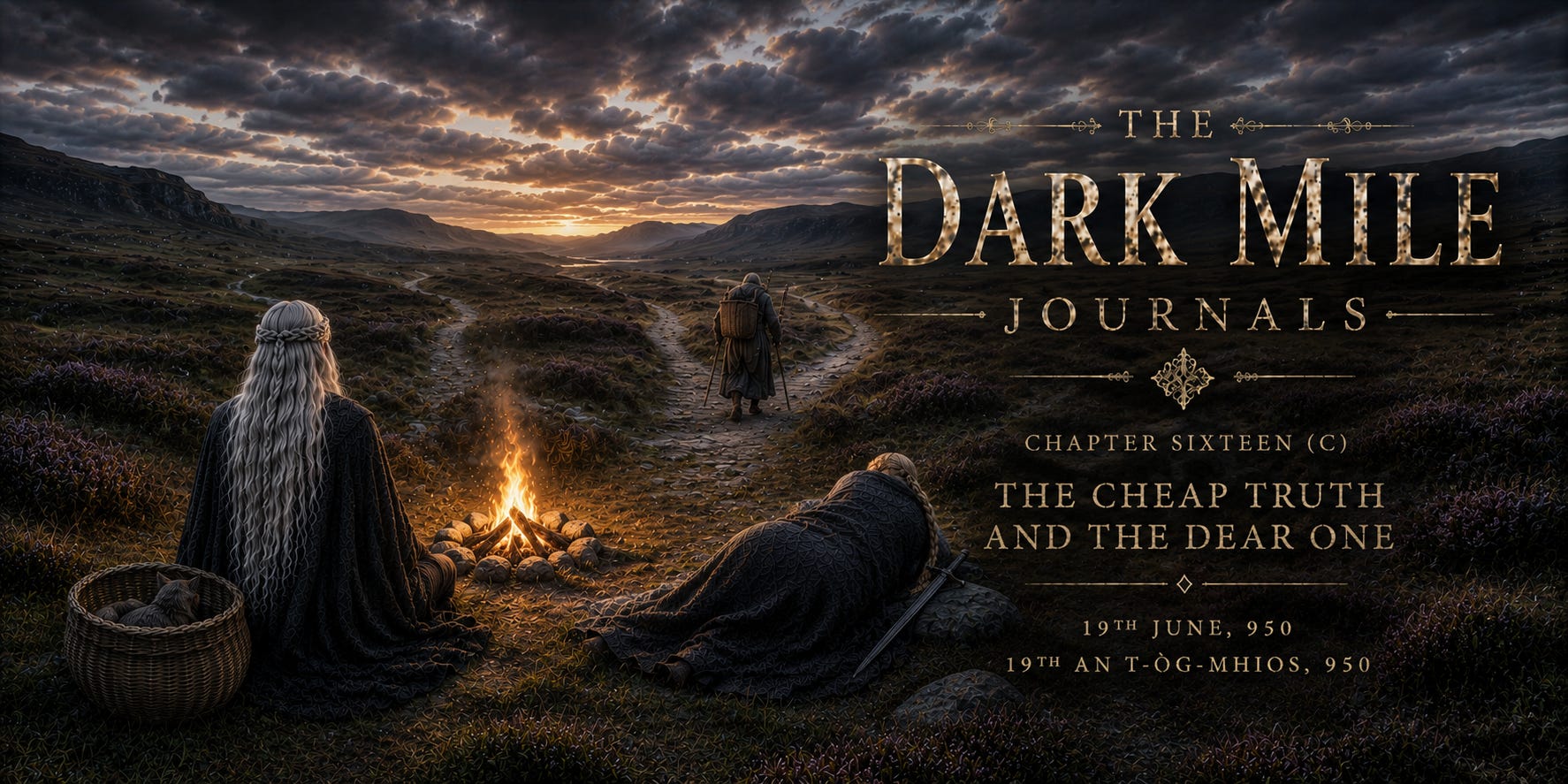
We came off the moor on the fifth day, ontae higher ground that kent its own name again, and the relief of walking on earth that didnae lie about whether it was earth nearly undid me more than the moor had. Runa allowed us a fire that night, the first since the ford. She judged the ground safe enough for it. I didnae argue. Brushy sang the whole evening through, making up for the silence she’d kept across the water. I let her. And I will set down that the sound of her was the closest tae comfort I had felt since I left m’own door.
The woman came tae the fire near the end of it.
I say woman. She had the silhouette of one — old, bent, a creel on her back as though she were out gathering, which nae one is, on that ground, at that hour. Runa was on her feet wi’ the blade before the form had finished arriving. I put a hand out. This was nae creature of the moor’s. This was older and far more tired, and wanted nae part of us as meat, one of the wandering sort, the ones who walk the edges of places and trade in what they have seen. What they have seen is all they own, and so they are careful wi’ it. She wanted the fire. I let her have a share of it. It is cheap, and the old ones remember who was open-handed.
She warmed herself a while and said naething, which is manners, among her kind. Then she asked where we were bound, and I had learned at the ford what these askings cost and what they are worth, so I told her true: east, past the moor we’d crossed, after a child.
She made a sound at that. Nae a word, the small noise that comes when what’s said willnae fit what ye already ken. And she told me, careful as they are careful wi’ all they own, that I was going wrong. That there was indeed a child, but nae east. South, she said, and inland, down off the high country intae the soft green straths where the people are thicker on the ground. A child that aged nae as a child should age. The mortals down that way had it at two winters old, she said — but she offered the number lightly, wi’ a look that said she kent as well as I did what a mortal’s count is worth against a fae-born bairn. She had the tale from another of her sort, who had it from the wind off that ground, and she gave it tae me plainly, as ye hand over a true thing, because she believed it was the child I sought and she meant me a kindness.
I didnae take it as she meant it.
I hae sat wi’ it since, and I will set the trouble of it down honestly, because the trouble is the point. The water at the ford said east, past the moor, and said it had cost me a true thing tae be told. This one says south and inland, meant me well, and her telling cost her naething tae give and me naething tae take — which is its own kind of warning. The cheap truth and the dear one dinnae always agree, and when they disagree a wiser creature than I might ask which is which. There is a child east. There is, it seems, a child south. And here is where a careless woman would find her answer and be wrong: m’own bairn hasnae seen a full turn of the year; the mortals put the southern child at two winters; so by any plain reckoning the southern child isnae mine, and the matter’s settled. But a mortal’s count is worth naething against a bairn that ages as fae bairns age — they cannae tell ye the years of one whose years dinnae run as theirs do, and the woman kent it, gave me the number regardless, and let me see that she kent. So the one measure I hae, the one plain sum that ought tae rule a child in or out, is the very measure I cannae trust. I dinnae ken whether the two of them are seeing one child from different sides, or two children entirely, nor whether either is mine, nor how a woman who doesnae ken her own bairn’s face, and cannae even count its years against another’s, is meant tae tell one strange child from another across the whole green back of the country.
The wandering woman saw, I think, that she had given me a burden where she’d meant tae give me a gift. She didnae apologize — her kind dinnae — but she sat a while longer than she’d any need tae, which is the closest tae sorry they have. Then she took up her creel and went back tae walking the edges of places, and the dark took her in the ordinary way.
Runa asked me what she’d said. I told her. Runa thought about it as she thinks about everything — as though it were terrain. “Two leads,” she said. “One you paid for. One that came free.” She set another piece of wood on the fire. “We finish the one we paid for first.” Then she lay down wi’ her back tae the warmth and her face tae the dark, and slept as soldiers sleep: all at once, and entirely.
I didnae sleep. I sat wi’ the two directions, Brushy gone quiet in the basket against m’side, and I thought about what the creature at the ford had told me last, unasked, which I havenae been able tae let go of since — mind which of us has been looking for the other. East. South. A child that doesnae age right, in either telling. And me at a fire on high ground between the two, certain of this much only: that I am going tae be wrong at least once before I am right, and that I hae never in m’long life had less notion of which wrongness I was about tae choose.
But Runa had the right of it, as she has the right of most matters on a road. We finish the one we paid for first. East, then. In the morning.
These journals remain free tae any soul that finds the road through the pines. The keeping of them is nae small labour — long nights at the page, the remembering, the sorting of what happened from what the wind’s rearranged since. If the telling’s worth a coin or two a month tae ye, a paid subscription’s what keeps it coming, and keeps the gate open for those that hae none tae spare. And if ye’ve nothing tae give, give it nae mind — sit by the fire regardless. Ye’ll owe me naething for it, and we’ll call it even.
🏰If this drew you in, Sorcha’s world is still moving—step into Soul Castle: The Guardian & The Keeper, a series on Amazon: HERE